

 Deutsch
 中文
 日本語
 Português
 Français
 Español
 العربية

- October 27, 2026
- SERVICES
For manufacturers bringing products to market, demonstrating biological safety is more than just a regulatory requirement. It provides the scientific evidence needed to support product safety, meet regulatory requirements, and build confidence in your product and its claims.
But how do you know which safety tests your product needs?
It starts with understanding the regulatory requirements for your product and target market. From there, you can identify the right testing methods, including validated alternatives to your testing.
Let’s take a closer look.
1. Understanding the product safety and regulatory requirement
Depending on the product, its intended use and the target market, manufacturers may need to meet different regulatory requirements. Some key regulatory frameworks include:
- European Union: Medical Device Regulation (MDR) 2017/745 and Biocidal Products Regulation (BPR) 528/2012
- ASEAN: ASEAN Pharmaceutical Regulatory Policy (APRP), ASEAN Medical Device Directive (AMDD), ASEAN Cosmetic Directive (ACD), and ASEAN Harmonised Cosmetic Regulatory Scheme (AHCRS)
- United States: Federal Food, Drug, and Cosmetic Act (FD&C Act) and Modernization of Cosmetics Regulation Act of 2022 (MoCRA)
- Australia: Therapeutic Goods Act 1989 and Therapeutic Goods (Medical Devices) Regulations 2002
The specific product safety requirements depend on factors such as the product classification, intended use, type and duration of exposure and potential biological risks.
Internationally recognized testing frameworks can help support these assessments, such as the ISO 10993 series for medical devices and OECD Test Guidelines (TGs) for toxicological testing.
Depending on the product, the resulting data may also contribute to technical documentation, risk assessments, or safety documentation such as the Safety Data Sheet (SDS).
2. So, what is ISO 10993 series & OECD Test Guidelines (TGs)?
If you manufacture medical devices, you have probably come across ISO 10993 series.
Simply put, the ISO 10993 series provide a framework for evaluating how a medical device interacts with the human body.
The type of assessment depends on how, where and for how long the device comes into contact with the human body.
On the other hand, the OECD Test Guidelines (TGs) provide standard methods for assessing chemical safety such as biocidal products and other product type.
Some of the most familiar testings includes:
- Cytotoxicity
- Skin irritation
- Skin sensitization
But here is where things get interesting.
3. From guinea pigs and rabbits to human tissue model
For many years, skin irritation, corrosion and sensitization testing relied heavily on animal models.
Today, that is changing.
Research into reconstructed human skin models began several decades ago. In the 1990s, pre-validation studies demonstrated their potential for skin corrosion testing. This eventually led to the adoption of an OECD test method in 2002, marking an important step toward internationally recognized alternatives to animal testing.
Since then, the field has continued to grow.
Today, validated and internationally recognized in vitro methods using reconstructed human tissue model are available for several biological testings, accepted by the regulatory framework, these methods replace or reduces the need for certain animal tests.
What exactly is a reconstructed human tissue model?
Think of it as human tissue recreated in the laboratory.
Human-derived cells are grown on a supportive matrix to create a three-dimensional model that reproduces all the important characteristics of the human tissue.
For example, reconstructed skin models can reproduce all the key features of the human skin and demonstrate biological activity, including responses associated with irritation and inflammation.
So, this is not simply an artificial material sitting on a surface.
It is a real, living, metabolically active, human cell-based model designed to produce specific functions of the human tissue.
And this leads to an important question for manufacturers:
4. Animal vs in vitro human tissue models: Which Better Predicts Human Responses?
Animal models can provide valuable information. However, animals are NOT humans.
Differences in skin structure, physiology, metabolism and biological responses between species can affect how accurately animal results predict human responses.
Here reconstructed human tissue models offer an important advantage, offering a more human – relevant approach. Designed to reproduce key characteristics of human tissue.
In 2020, De Jong et al. compared reconstructed human skin models with traditional in vivo irritation tests, reporting broadly comparable irritation outcomes proving the potential as an alternative approach.
Beyond scientific relevance, growing concerns about animal welfare and the limitations of translating animal data to humans have increased the alternatives testing methods. For example, the EU Cosmetics Regulation (EC) No. 1223/2009 also restricts animal testing for cosmetics and the marketing of certain animal-tested cosmetic products.
What about regulatory acceptance?
Reconstructed human tissue models are already recognised in several regulatory frameworks.
- OECD TG 439: Uses reconstructed human epidermis to assess skin irritation.
- OECD TG 431: Uses reconstructed human epidermis to assess skin corrosion.
- OECD TG 492: Uses reconstructed human cornea-like epithelium to assess eye irritation or serious eye damage
These methods can replace specific animal tests when their applicability criteria are met.
5. Is in vitro testing more expensive?
The answer? It depends on the study and testing requirements.
Animal testing may sometimes appear cheaper, depending on the study, location and requirements. But test price should not be the only deciding factor when choosing a testing strategy.
A sound testing strategy should also account for:
- Regulatory acceptance in the target market
- Reproducibility and consistency of the results
- Relevance to human biology
- Animal welfare considerations
- Customer and consumer expectations
- The possibility of repeating test when results are inconclusive
Rather than comparing prices alone, manufacturers should ask:
“Which testing approach gives me the most relevant and reliable information about my product?”
Choosing the right method from the beginning can help avoid unnecessary testing and support a more efficient product development process.
6. What can you test with reconstructed human tissue models?
At TECOLAB, we use reconstructed human tissue models from MatTek to support established testing standards, including:
- ISO 10993-23 – Skin irritation of medical devices
- OECD TG 431 – Skin corrosion
- OECD TG 439 – Skin irritation
- OECD TG 492 – Eye irritation
These models can support the evaluation of a wide range of products, including medical devices, cosmetics, personal care products, toiletries, household cleaners, industrial cleaners, and other consumer or chemical products.
However, the suitability of each method depends on the product, the test endpoint, and the applicable regulatory requirements.
Is it only skin and eye?
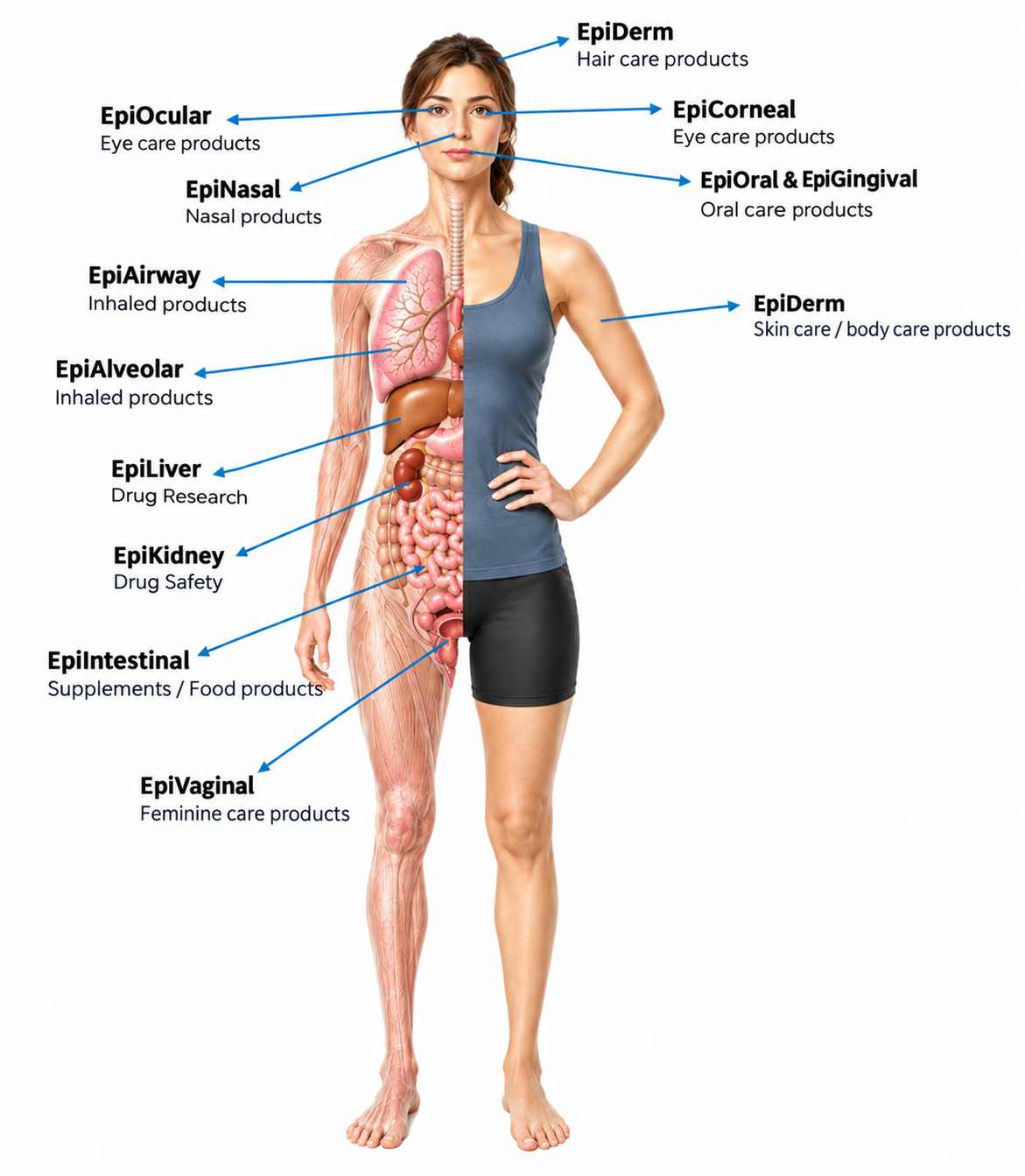
Absolutely NOT. Reconstructed human tissue technology has evolved far beyond skin and eye models.
Depending on the biological question, different tissue models can be used to study product interactions, toxicity and biological responses.
Human tissue models are now available for a growing range of applications, including:
- Oral
- Respiratory
- Nasal
- Liver
- Kidney and more
The right model can help bring safety testing closer to human biology—while supporting the global move toward more ethical and sustainable product development.
Reconstructed Human Tissue Models at a Glance
7. Should in vitro toxicological testing be conducted under ISO/IEC 17025 or GLP?
For in vitro toxicological testing, the right approach depends on your purpose and target market.
Although both support confidence in testing data, they serve different purposes.
For R&D and internal use, ISO/IEC 17025 accredited testing is often sufficient.
For regulatory submissions, requirements depend on your target market and regulations. For example, the EU BPR requires GLP for relevant safety studies, while the EU MDR and ASEAN requirements may differ.
Not sure which approach is right for your product? Read our previous blog on the differences between OECD GLP and ISO/IEC 17025 to learn more.
or
Let TECOLAB Help You Find the Right Testing Approach
At TECOLAB, we make the testing journey simpler.
From selecting the right tissue model and test method to meeting the right standards and regulatory requirements, we help you find the best fit for your product.
Your product. The right model. Reliable data. Regulatory Acceptance. Let’s make that happen. Talk to Us here
References:
International Organization for Standardization. (2021). Biological evaluation of medical devices — Part 23: Tests for irritation (ISO Standard No. 10993-23:2021). ISO Standard 74151
OECD (2021), Test No. 439: In Vitro Skin Irritation: Reconstructed Human Epidermis Test Method, OECD Guidelines for the Testing of Chemicals, Section 4, OECD Publishing, Paris.
OECD (2025), Test No. 431: In vitro skin corrosion: reconstructed human epidermis (RHE) test method, OECD Guidelines for the Testing of Chemicals, Section 4, OECD Publishing, Paris.
OECD (2023). Test No. 492: Reconstructed human Cornea-like Epithelium (RhCE) test method for identifying chemicals not requiring classification and labelling for eye irritation or serious eye damage. OECD Guidelines for the Testing of Chemicals, Section 4, OECD Publishing. https://doi.org
De Jong, W. H., Carraway, J. W., Liu, C., Fan, C., Liu, J., Turley, A. P., Rollins, T. S., & Coleman, K. P. (2020). The suitability of reconstructed human epidermis models for medical device irritation assessment: A comparison of in vitro and in vivo testing results. Toxicology in Vitro, 69, 104995. https://doi.org/10.1016/j.tiv.2020.104995