If yes, viral safety is an important part of your quality control and regulatory strategy.
Why viral safety matters?
Biological products and their manufacturing processes can involve cell substrates, animal-derived materials, and other biological components that may introduce a potential risk of viral contamination.
A contamination event can have serious consequences:
MIT Consortium on Adventitious Agent Contamination in Biomanufacturing (CAACB) has recorded a number of viral contamination events in biological products such as fetal bovine serum, vaccine and cell line manufacturing. One of the most notable incidents was the contamination of biopharmaceutical manufacturing Chinese Hamster Ovary cells by Vesivirus 2117, which resulted in production losses exceeding US$200 million.
This is exactly why regulators expect manufacturers to establish appropriate controls to prevent and detect microbiological contamination as early as possible. For example, 21 CFR 211.113(a) requires appropriate written procedures to prevent objectionable microorganisms in drug products and to prevent microbiological contamination of drug products that are required to be sterile.
For biotechnology products derived from human or animal cell lines, ICH Q5A(R2) provides a framework for viral safety evaluation, including appropriate viral testing and assessment of viral clearance.
Detecting a virus is only part of the question.
You need the right test to understand what that detection means.
At TECOLAB Sdn Bhd, we offer a comprehensive viral safety testing that can be selected individually or combined, depending on your product, development stage and risk assessment needs.
We offer three key approaches:
1) Next-Generation Sequencing (NGS)
A highly sensitive molecular technique that analyses genetic material present in a sample.
It enables broad detection of:
Known viral sequences
Unexpected or emerging viral sequences
Low-abundance viral genetic material
Because NGS detects nucleic acids, it can identify viral genetic signatures regardless of whether the virus is infectious or not.
This is why, NGS is used as a powerful screening tool
but it does not answer the question of whether a detected virus is capable of replication and infection.
For that, we need a functional assay, the infectivity assay.
2) In vitro Cell Culture Infectivity Assay
Molecular detection tells you that viral genetic material may be present.
A cell-based infectivity assay answers a different question:
“Is the virus infectious and able to replicate?”
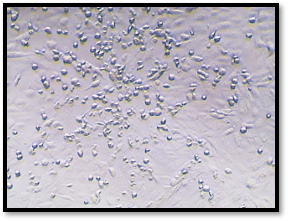
The in vitro infectivity assay addresses this question by exposing the susceptible cell cultures to the test material and monitor for 14 or 28 days for any signs of viral replication, the cytopathic effects (CPE).
If the potential contaminating virus is known, suitable cell lines can be selected to improve the likelihood of detecting relevant viral contaminants.
For broader screening of unknown viral contaminants, an adventitious virus detection assay may be applied using multiple cell system, such as:
MRC-5 cells: To detect viruses that pose human safety risk (clinically relevant host)
Vero cells: Serve as a broad-spectrum virus detector
Cell line of the species origin: To detect species-specific viruses
Example of Poliovirus CPE on Vero cells. Left picture is the healthy viable Vero cell; right picture is the CPE caused by Poliovirus.
However, cell culture infectivity testing also has limitations. Some viruses are difficult or impossible to propagate using conventional cell culture system, while some may not produce a detectable CPE. Low levels of infectious virus may also fall below the assay’s detection capability. Not only that, cytotoxicity from the test material can damage the cells and make CPE interpretation more difficult.
3) Replication-Competent Adenovirus (RCA) Assay
For products manufactured using adenoviral vectors, a specific concern is the potential presence of replication-competent adenovirus (RCA).
During manufacturing, rare recombination events can potentially generate infectious adenoviruses capable of replication.
Our RCA testing approach uses A549 cells, which are suitable for supporting adenovirus replication, to help detect replication-competent adenovirus in the test material.
This provides a targeted assessment when RCA is a specific product-related risk.
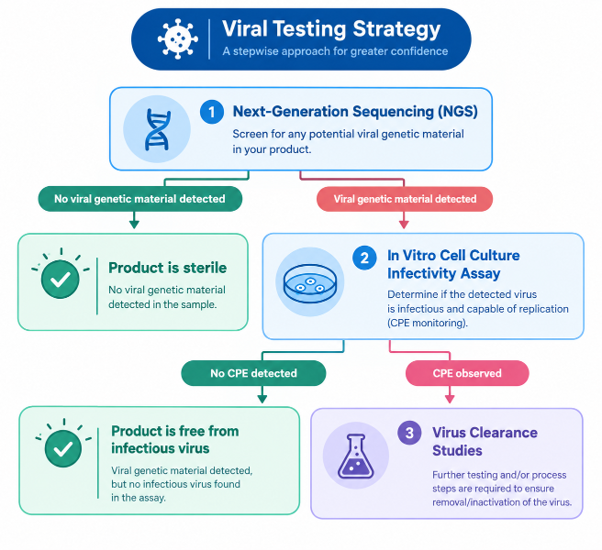
Not sure where to start? Below is decision pathway to help you to make decision.
But fret not— you may not need both tests. The right approach depends on what you need to know and your product-specific risk assessment.
Think of the three approaches as answering three different questions:
These approaches provide different types of information and may be used together when justified by the product-specific risk assessment.
At TECOLAB Sdn Bhd, we work with manufacturers to develop scientifically appropriate viral safety testing strategies based on their specific product and risk profile.
Whether you need:
Broad molecular screening, functional infectivity testing, or targeted RCA assessment
Our goal is to help you generate meaningful data that supports product safety, quality and regulatory confidence.
Talk to our team about the testing strategy that fits your product.


 Deutsch
 中文
中文
 日本語
日本語
 Português
 Français
 Español
 العربية