Quantitative enumeration of aerobic bacteria (TAMC) and fungi (TYMC) for non-sterile pharmaceutical products.
USP <61> is a United States Pharmacopeia method for the quantitative enumeration of viable aerobic bacteria (TAMC) and fungi (TYMC) in nonsterile pharmaceutical products. The test assesses the level of viable microorganisms present to support product quality, safety, and regulatory compliance.
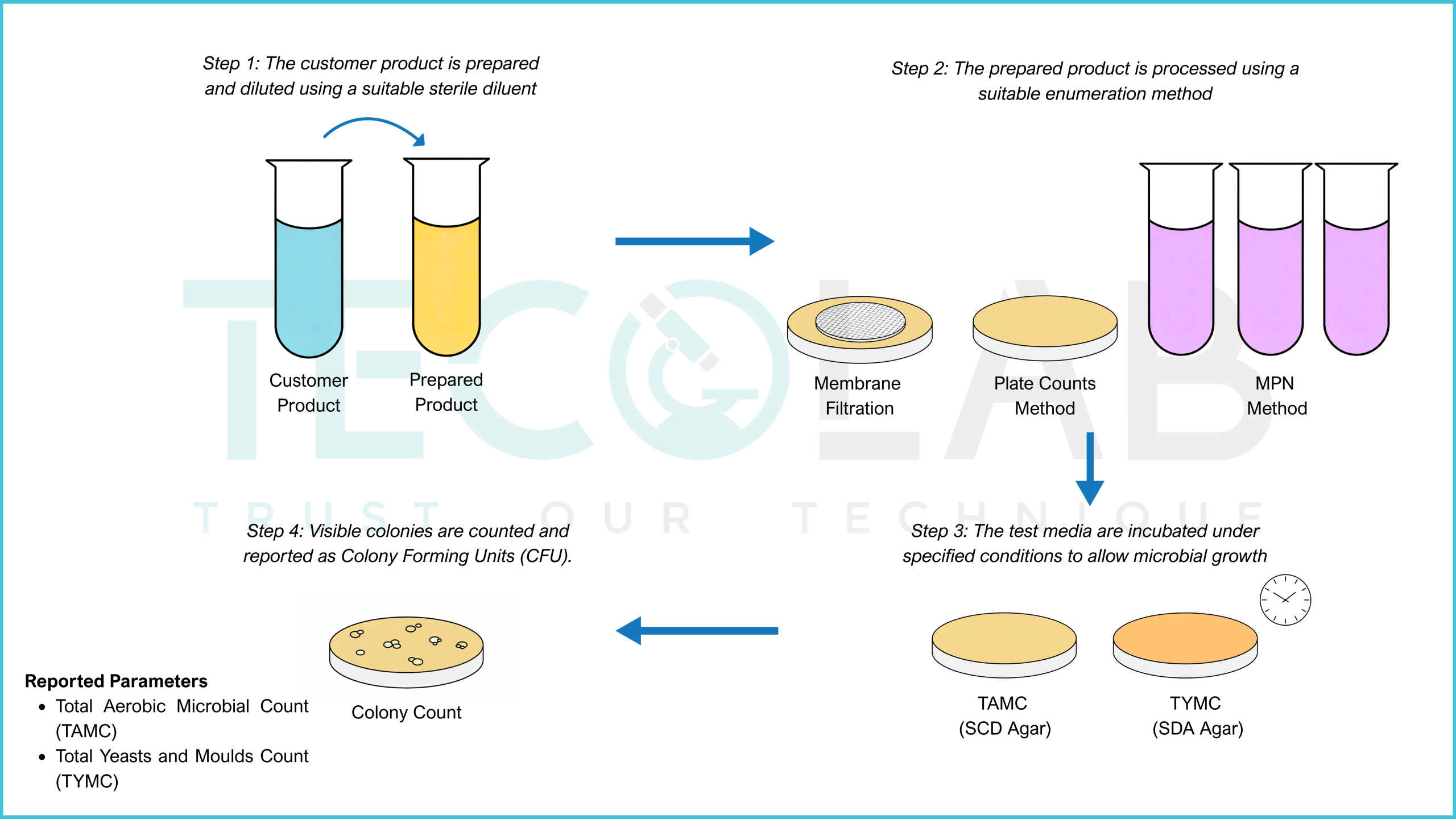
The infographic below provides a brief overview of the USP <61> test method.
USP <61> is used for the quantitative enumeration of viable microorganisms in nonsterile pharmaceutical products and other applicable products.
The test determines the levels of:
Total Aerobic Microbial Count (TAMC)
Total Yeasts and Moulds Count (TYMC)
The appropriate enumeration method is selected based on the characteristics of the product and its suitability for microbial recovery.
Test Microorganisms
USP <61> is used to enumerate viable microorganisms that may be present in the test product, including:
Aerobic bacteria
Yeasts
Moulds
Suitable culture media and specified incubation conditions are used to support microbial recovery and enumeration.
Test Protocol
Step 1: Prepare the Test Product The customer product is prepared and diluted using a suitable sterile diluent according to the characteristics of the product and applicable USP <61> requirements.
Step 2: Perform Microbial Enumeration The prepared product is processed using a suitable microbial enumeration method according to the product characteristics and applicable USP <61> requirements. Enumeration methods may include:
Membrane filtration: The prepared product is passed through a membrane filter to retain microorganisms. The membrane is then transferred to a suitable culture medium for incubation and enumeration.
Plate-count methods: The prepared product is tested using suitable plate-count techniques, such as the pour plate or spread plate method. Following incubation, visible colonies are counted.
Most Probable Number (MPN): The prepared product is inoculated into suitable culture media using a series of dilutions. Following incubation, the presence or absence of microbial growth is evaluated, and the microbial count is estimated using the MPN method.
Method selection: The appropriate enumeration method is selected based on the characteristics of the product and its suitability for microbial recovery and enumeration.
Step 3: Incubate the Test Media The samples are incubated under appropriate temperature and time conditions to allow the recovered microorganisms to grow and form visible colonies.
Bacteria: Incubated at 30–35°C for 3 days using Tryptic Soy Agar (TSA).
Yeasts and moulds: Incubated at 20–25°C for 5 days using Sabouraud Dextrose Agar (SDA).
Step 4: Count and Report the Results The results are reported as colony-forming units (CFU) or the applicable quantitative result obtained from the selected enumeration method.
Results are reported as:
Total Aerobic Microbial Count (TAMC)
Total Yeasts and Moulds Count (TYMC)
Acceptance Criteria
Acceptance criteria are evaluated according to USP <1111> and other applicable regulatory requirements. The applicable microbial limits depend on factors such as the product category, route of administration, and intended use.
Need help with your testing requirements?
Have questions about this test method or your product? Our technical team is here to assist you.


 Deutsch
 中文
中文
 日本語
日本語
 Português
 Français
 Español
 العربية