

 Deutsch
 中文
中文
 日本語
日本語
 Português
 Français
 Español
 العربية


For manufacturers developing disinfectants, hand rubs, surface and instrument disinfectants, virucidal claims can be a powerful marketing tool. To make these claims, it must be supported by validated efficacy testing data. One of the most widely recognized standards is EN 14476, a quantitative suspension test designed to evaluate the virucidal activity of a product. Although the test principle is straightforward, interpreting the results is not always simple. Cytotoxicity, in particular, can significantly influence how results are reported and understood. How so?
Understanding key concepts such as cytotoxicity, limit of detection (LOD), and log reduction is essential to accurately interpret the results and product performance. Before we dive deeper, let us briefly look at how EN 14476 works.

In EN 14476 testing, the test product is mixed with an interfering substance and a virus suspension and allowed to remain in contact for a specified period. After the contact time, the reaction is stopped by transferring the mixture into an ice-cold medium. The mixture is then serially diluted and added to host cells cultured in a 96-well plate. These living host cells are used to determine whether any infectious virus remains after the exposure with test product. If infectious virus is present, it will infect the cells and cause cell damage or cell death, known as cytopathic effects (CPE).
However, a key challenge arises here.
Cell damage or death is not always caused by virus. Sometimes, the residual test product carried over from the reaction tube can also damage or kill host cells, this is known as cytotoxicity. This makes it difficult to distinguish between virus-induced (CPE) and product-induced (cytotoxicity effects). Although an experienced virologist can often distinguish between CPE and cytotoxicity effects on the cells, visual interpretation alone is not always reliable or definitive.
To address this, cytotoxicity control is performed in parallel with the efficacy test. This determines the level of cytotoxicity and the dilution which it is no longer observed. Only results beyond this point are considered reliable. When cytotoxicity is present, results can only be interpreted at higher dilutions. This increases the limit of detection (LOD) and reduces the maximum log reduction that can be demonstrated. To better understand the relationship between cytotoxicity, limit detection (LOD) and log reduction, let us look at the scenarios below:
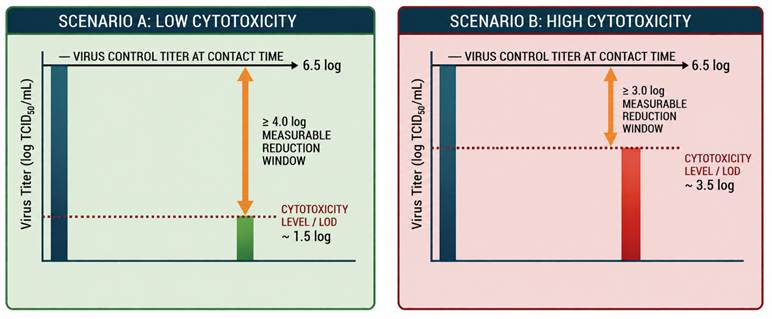
Log reduction refers to the reduction of infectious virus after exposure to the product. To meet the EN (European standard) and TGA (Australia) regulation requirement, a product must demonstrate at least ≥4.00 log reduction, while for EPA regulation, it is ≥3.00 log reduction. However, when high cytotoxicity is present, TGA regulation accepts products with ≥3.00 log reduction, with complete inactivation of virus as effective.
What does the “ > ” symbol mean in the results?
You may see this reported in the results a lot. It is important to pay attention and not ignore the “ ≥ ” symbol.
For example, a result reported as ≥3.00 log₁₀ reduction does not mean the product achieved exactly 3.00 log reduction. Rather it means that:
- The actual reduction is at least 3.00 log
- The exact log reduction may be higher
- The exact reduction cannot be measured due to assay limitation caused by cytotoxicity and virus titer.
In practical terms, no virus-induced CPE was detected beyond the cytotoxicity endpoint, meaning no infectious virus was detected within the limits of the test method.
How to improve detection and reduce LOD?
When cytotoxicity limits the ability to demonstrate the required log reduction, several strategies can help improve test sensitivity:
- Higher virus titer
- Higher starting virus titer increases the maximum demonstrable log reduction but is limited by the virus and cell culture system.
- Molecular sieving (Microspin)
- Removes residual test product after the contact time, helping to reduce cytotoxicity effects on the host cells.
- Large-volume plating
- Improves the test sensitivity by allowing larger volume of the test mixture, thereby lowering detection limit.
High cytotoxicity does not necessarily mean that the product if ineffective. Rather, it limits the laboratory’s ability to measure the true extent of virus inactivation.
By understanding the relationship between cytotoxicity, LOD, and log reduction, manufacturers can better interpret the virucidal efficacy results and understand the limitations of the test method.
At TECOLAB, we work closely with our customers to overcome technical challenges and optimize testing strategies at no additional cost. By combining technical expertise with a collaborative approach, we help our customers achieve their goals while building long-term partnerships based on trust, reliability, and mutual success. Drop us an email now to start your efficacy testing journey with us.