

 Deutsch
 中文
中文
 日本語
日本語
 Português
 Français
 Español
 العربية

Bioburden testing for medical devices prior to sterilization
ISO 11737-1 specifies requirements for the determination of bioburden on medical devices, components, raw materials, and packaging before sterilization. The test determines the level of viable microorganisms present, providing essential information for sterilization validation and microbiological control.
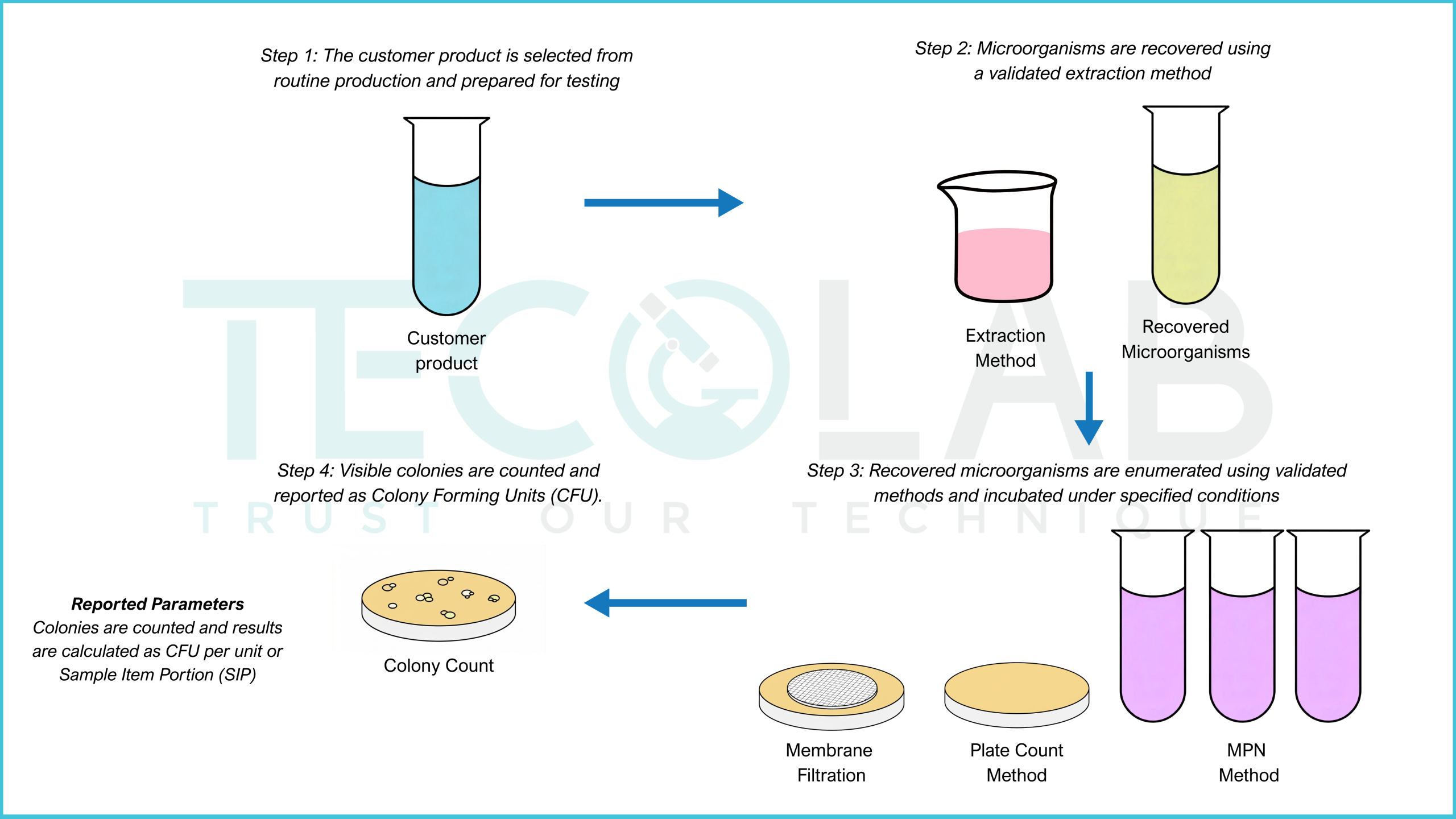
The diagram below summarizes the ISO 11737-1 test method.

TESTING CRITERIA AND CUSTOMER PROCESS
Step 1: How is the sample prepared?
A representative product sample or Sample Item Portion (SIP) is selected from routine production, including packaging where applicable. Microorganisms are then recovered using a validated extraction method suitable for the product type.
Step 2: How many samples are required?
The number of samples tested is determined based on product specifications, validation requirements, and the established sampling plan. For routine testing, TECOLAB typically recommends testing 3 product units or Sample Item Portions (SIPs), where applicable.
Step 3: Which enumeration methods are used?
The recovered microorganisms are counted using a validated enumeration method appropriate for the product and sample. Common methods include:
- Membrane filtration: The sample is passed through a filter that captures the microorganisms. The filter is then placed on a suitable growth medium for incubation and counting.
- Pour plate method: The sample is mixed with molten agar and allowed to solidify. After incubation, the resulting colonies are counted.
- Spread plate method: The sample is spread evenly over the surface of an agar plate. After incubation, the resulting colonies are counted.
The appropriate method is selected based on the product characteristics and expected microbial level.
Step 4: What are the incubation conditions?
The samples are incubated under appropriate temperature and time conditions to allow recovered microorganisms to grow and form visible colonies.
- Bacteria: Incubated at 30–35°C for 3 days using Tryptic Soy Agar (TSA).
- Yeasts and moulds: Incubated at 20–25°C for 5 days using Sabouraud Dextrose Agar (SDA).
Step 5: What are the acceptance criteria?
Acceptance criteria are defined based on product specifications, risk assessment, and regulatory requirements. Internal limits (e.g., <50 CFU per device) may be applied depending on product requirements.
Step 6: Place an order and send your sample to us
Fill in the test request form and place an order via email at info@tecolab-global.com. We will advise on the quantity of sample required for testing.
You can deliver the sample to us via courier or our sample delivery service and provide us the tracking code. We will monitor the delivery status and inform you when we receive the sample.
Step 7: Track the status of your request
Once we have received your sample, we will provide a tracking number to you. You can easily track the status of your request here.
Step 8: Download your password-protected test report
Download your readily available test report online with just a single click using the link and password provided via email notification. We will receive a notification once you have downloaded the test report.
For safety purposes, the uploaded test report will self-destruct after 7 days.