
 Deutsch
 中文
中文
 日本語
日本語
 Português
 Français
 Español
 العربية

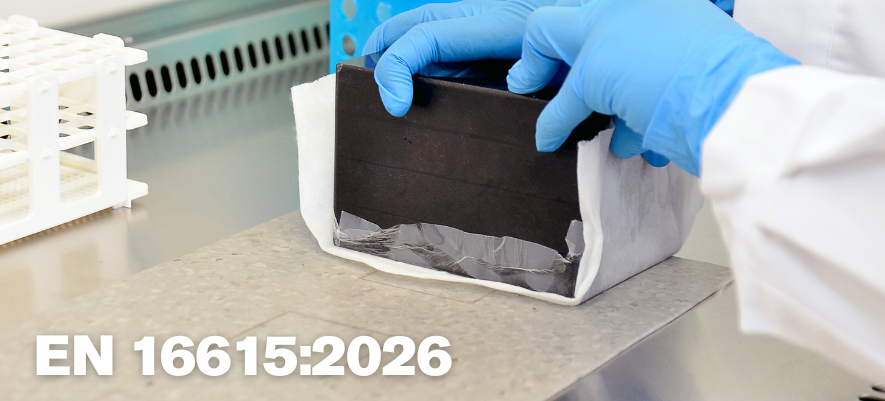
The latest revision of EN 16615 was published in April 2026 with major updates to the standard. This includes expanded spectrum of activity (fungicidal and mycobactericidal activity) with additional test runs and replicates, harmonizing this standard with other EN standards to ensure greater consistency and reliability.
EN 16615 is the Phase 2, step 2 carrier test for evaluating bactericidal, yeasticidal, fungicidal, tuberculocidal and mycobactericidal activity of disinfectants with mechanical action employing wipes or mops used in the medical area (4-field test). This revision replaces the EN 16615:2015 version.
How does EN 16615:2026 differ from the previous version? Will these changes affect your product claims? Does additional testing need to be done? Here is all you need to know about the new EN 16615:2026 standard and how it may impact your product claims.
What’s new in EN 16615:2026?
In this blog, we focus on the major changes affecting testing conditions and product claims that manufacturers and end users should be aware of, with less emphasis on the technical test procedure implementation by laboratories.
1. Expansion to the spectrum of activity
In addition to bactericidal and yeasticidal activity established in the previous version, the 2026 revision now includes fungicidal activity and tuberculocidal/mycobactericidal activity. This allows all spectrum of activity claims (except virucidal activity, soon to be released with prEN 18368) to be covered under EN 16615 for surface disinfectants applied with mechanical action in the medical area.
The obligatory microorganisms and passing criteria for each activity remain harmonized with the other EN standards in the medical area, as outlined below:
| CLAIM | TEST MICROORGANISMS | PASSING CRITERIA |
| Bactericidal activity | Staphylococcus aureus Pseudomonas aeruginosa Enterococcus hirae |
5 log reduction |
| Yeasticidal activity | Candida albicans | 4 log reduction |
| Fungicidal activity | Candida albicans Aspergillus brasiliensis |
4 log reduction |
| Tuberculocidal activity | Mycobacterium terrae | 4 log reduction |
| Mycobactercidal activity | Mycobacterium terrae Mycobacterium avium |
4 log reduction |
2. Test schedule and conditions
The EN 16615:2026 have included additional test runs and repetitions to be tested with replicates according to the following test schedule, allowing more consistent, accurate and reliable data to be reported. This change to the test schedule aligns EN 16615 with EN 17846, the 4-field test for sporicidal activity against C. difficile published in 2023 as well as the VAH methods commonly practiced for German market.
| CLAIM | 1ST TEST RUN | 2ND TEST RUN |
| 1 carrier, 2 concentrations or contact time | 2 carriers, claimed concentration and contact time | |
| Bactericidal activity | Staphylococcus aureus Pseudomonas aeruginosa Enterococcus hirae |
Most resistant test organism |
| Yeasticidal activity | Candida albicans | Candida albicans |
| Fungicidal activity | Candida albicans Aspergillus brasiliensis |
Most resistant test organism |
| Tuberculocidal activity | Mycobacterium terrae | Mycobacterium terrae |
| Mycobactercidal activity | Mycobacterium terrae Mycobacterium avium |
Most resistant test organism |
In the first test run, a minimum of 2 concentrations should be evaluated with one in the active range and one in the non-active range to demonstrate the limiting range of activity. For ready-to-use or pre-impregnated wipes, dilution to a lower concentration may not be feasible. In such cases, the non-active range can be demonstrated with a shorter contact time instead.
Besides that, humidity of the test environment is now to be measured and documented. Variations in humidity conditions play an essential role in the test and can influence the test outcome. Application of the product under low humidity conditions may lead to faster drying of the product on the surface than expected, resulting in reduced microbial reduction observed as compared to if applied in a moderate to high humidity environment. Documenting humidity therefore supports improved reproducibility of results.
3. Type of test surface
PVC without PUR surface coating (commercially known as FOREX material) with thickness of 2mm has been added as the standard test surface in EN 16615. This change in test surface material harmonizes the new EN 16615 with the EN 17846 standard. In addition to harmonization of standards, insights gained from studies and ring trials have shown that FOREX surface helps to avoid issues faced with drying sensitive microorganisms such as P. aeruginosa and C. albicans.
4. Drying time determination
Some test organisms are highly sensitive to drying which leads to difficulty in maintaining sufficiently high controls in this test. This drying time determination procedure is not new to the EN standards in general as it was introduced with EN 13697 back in 2023 but is now formally incorporated into EN 16615. In previous drying procedures, test organisms were left until visibly dry which may lead to reduced recovery of surviving organisms. Here, a fixed drying end point should be predetermined by the laboratory before the surface is visibly dry for each drying sensitive test organisms, allowing higher control recovery and more reliable data outcome.
Do you need to retest with the new revision?
Good news is the changes of this new revision have no impact on the test results, therefore results from EN 16615:2015 are still valid. Therefore, if you are maintaining your existing claims for bactericidal and yeasticidal activity, it is most likely you may not need retesting at this stage. However, for future claim or registration updates, you will need to have the testing done for the required additional data discussed above.
For the additional spectrum of activity including fungicidal and mycobactericidal activity, if your product has these claims based solely on suspension tests (Phase 2, step 1) previously, this EN 16615:2026 test must be additionally performed to remain compliant for your claims. According to Clause 8.1 in EN 14885, this additional data should be carried out within 18 months.
Fun fact, a prEN is currently under development for virucidal activity of surface disinfectants with mechanical action (4-field test), so expect this to be coming in the near future.
If you would like advice on whether the new EN 16615 revision affects your disinfectant claims, our experts here at TECOLAB are always available to help you navigate compliance with the latest standard, from reviewing your current reports to advising on future test planning.
TECOLAB always practices the latest revisions of the test methods as they are published. Drop us an email now to have your products tested according to the latest EN 16615:2026.