In-vitro eye irritation testing for biocides, chemicals and cosmetics
Eye irritation testing is performed using the EpiOcular model, which utilizes Reconstructed Human Cornea-Like Epithelium (RhCE). This method follows OECD 492, an internationally recognized guideline for assessing the eye irritation potential of biocides, chemicals, and cosmetics—without the need for animal testing.
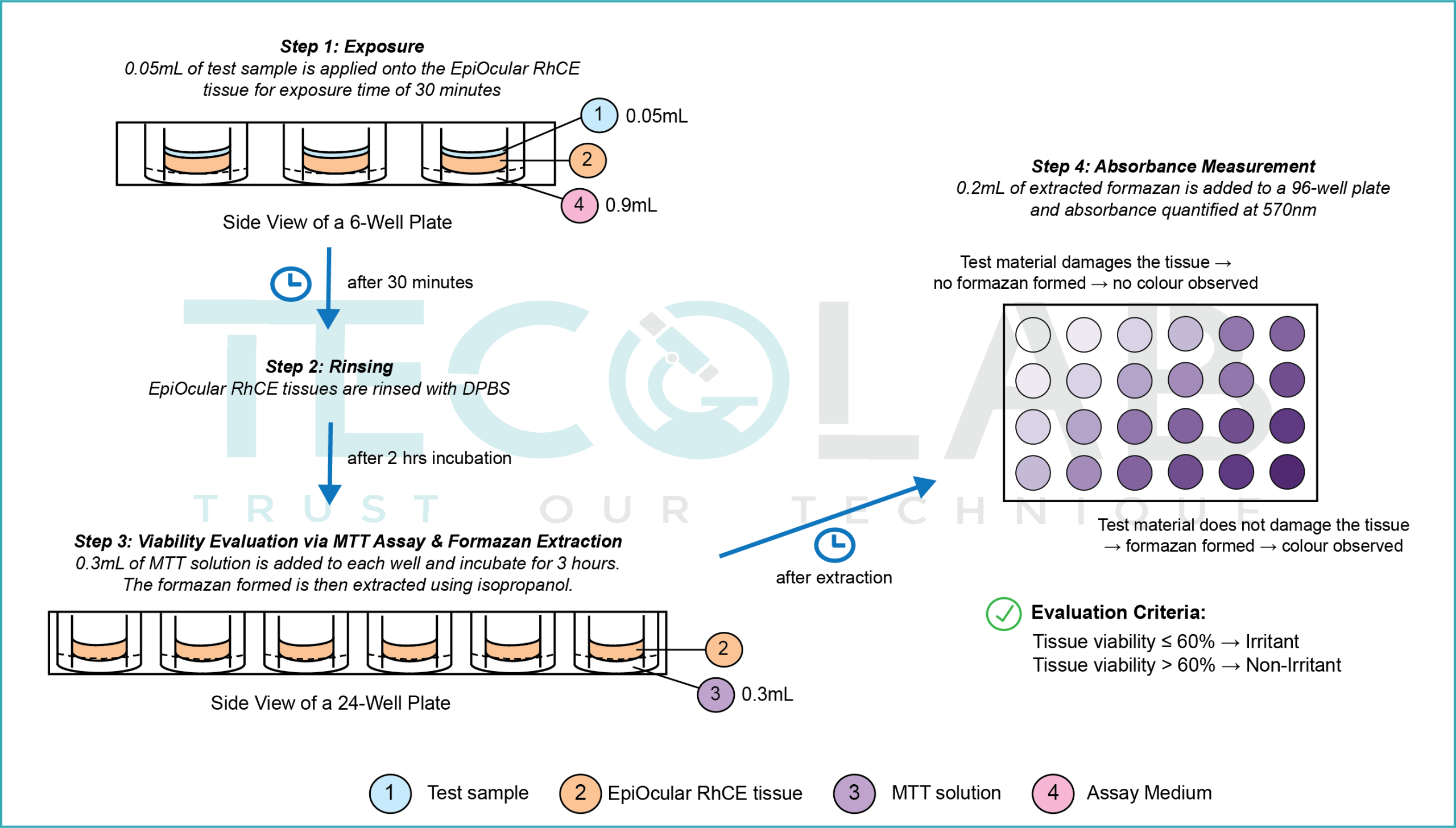
The diagram below provides a summary of the test method according to OECD 492.
OECD 492 is specifically designed for hazard identification of eye irritant chemicals, biocides, and cosmetics.
If your product is a medical device, eye irritation testing may still be required, but there is no dedicated ISO 10993 standard for in vitro eye irritation testing. Thus, this method may be used to screen for the eye irritation potential of medical devices, depending on the specific regulation.
Test Protocol
Step 1: 0.05 mL of the test sample is applied to the EpiOcular RhCE tissue and exposed for 30 minutes.
Step 2: The EpiOcular RhCE tissues are rinsed with DPBS.
Step 3: 0.3 mL of MTT solution is added to each well and incubated for 3 hours. The formazan formed is then extracted using isopropanol.
Step 4: 0.2 mL of the extracted formazan solution is transferred to a 96-well plate, and the absorbance is measured at 570 nm.
Exposure Time and Condition
The test substance is applied directly onto the Reconstructed Human Cornea-Like Epithelium (RhCE) for
Liquid samples: 30 minutes at 37°C
Solid samples: 6 hours at 37°C
Passing Criteria
If cell viability after post-exposure incubation is ≤ 60%, the tested product is classified as Irritant
If cell viability after post-exposure incubation is > 60%, the tested product is classified as Non-Irritant.
*Irritant products may require further testing for classification of hazard depending on specific regulations.
EU and GHS Hazard Classification
If the product is classified as Non-Irritant, it is not assigned a GHS category.
If the product is classified as Irritant, further testing may be required to differentiate between GHS Category 1 (Serious Eye Damage) and GHS Category 2 (Eye Irritation).
For irritant products, the GHS hazard classification can be further predicted using a modified protocol or the EPA Eye Irritation Hazard classification with the MTT ET50 Assay.
**Disclaimer: NO ANIMAL TESTING. TECOLAB is committed to ethical and cruelty-free testing practices. We do not conduct any form of testing on animals and all our biocompatibility tests are performed on in-vitro models.
Need help with your testing requirements?
Have questions about this test method or your product? Our technical team is here to assist you.


 Deutsch
 中文
中文
 日本語
日本語
 Português
 Français
 Español
 العربية