

 Deutsch
 中文
 日本語
 Português
 Français
 Español
 العربية

Counterfeit Product Assessment
Looks the same. Is it really the same?
Counterfeit and limitation products are becoming increasingly sophisticated. They often have identical packaging, labels, colour, and even odour, making them difficult to distinguish through visual inspection alone.
However, what looks identical on the outside may be very different on the inside.
How We Reveal the Differences
Step 1 — Does It Behave Like the Original?
The first clue often comes from the product’s physical properties.
We compare key physicochemical characteristics, including:
- pH
- Viscosity
- Density (Specific Gravity)
- Oxidation-Reduction Potential (ORP)
- Appearance
- Colour
- Clarity
- Odour
Even subtle changes can indicate formulation differences that are invisible to the naked eye.
Example:
Two disinfectants may both appear as clear, colourless liquids, yet one has a significantly lower ORP or different viscosity, suggesting changes in formulation or active ingredient performance.
Step 2 — Does It Have the Same Chemical Fingerprint?
Every formulation has its own unique chemical signature.
Using Fourier Transform Infrared (FTIR) Spectroscopy, we generate a chemical “fingerprint” by measuring how the product absorbs infrared light.
If a manufacturer substitutes raw materials, changes solvents, replaces surfactants, or omits formulation components, the FTIR spectrum changes even when the product looks identical.
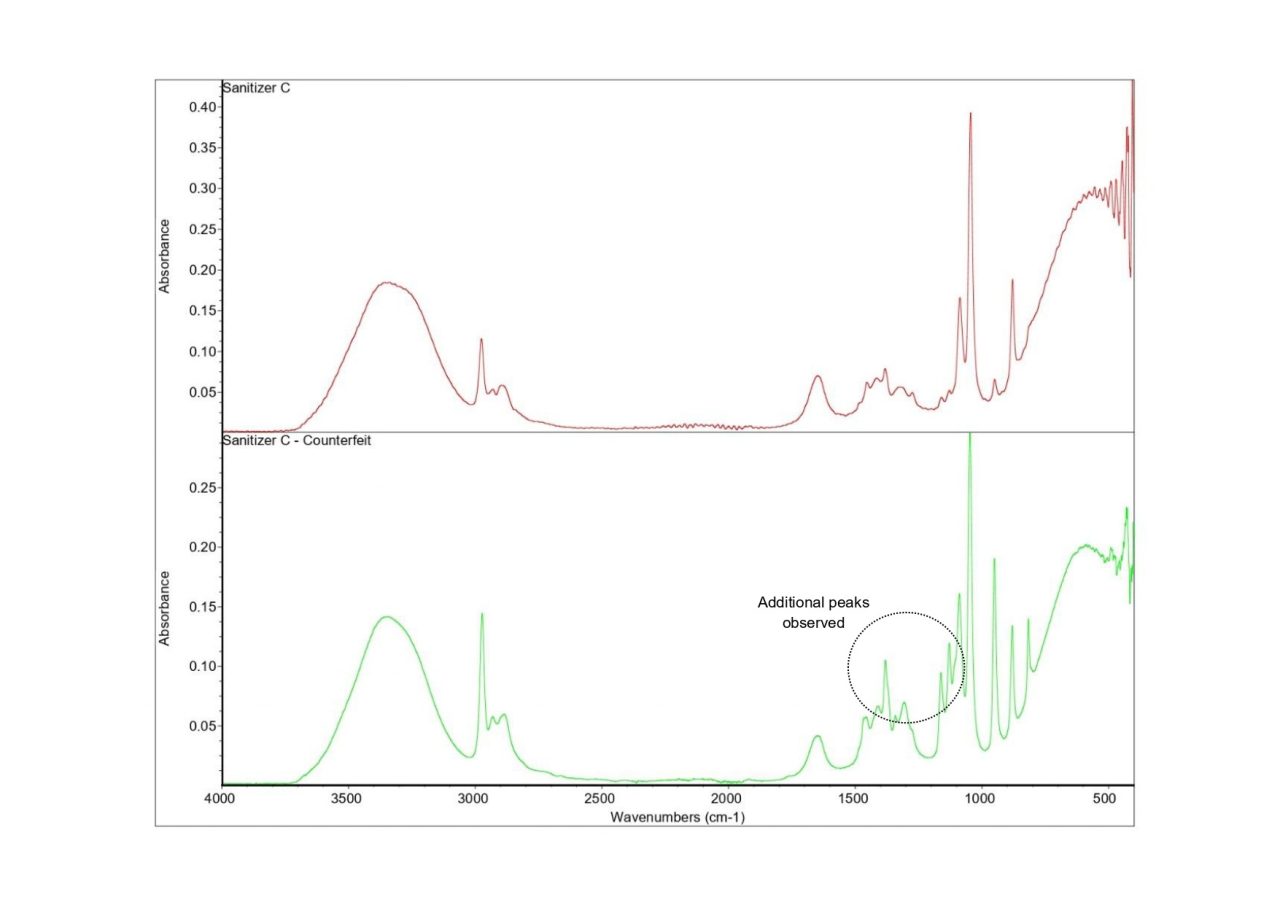
FTIR Analysis for Product Counterfeit Identification
Both products show general alcohol-related features, but their overall chemical fingerprints differ substantially, particularly in the 1000–1500 cm⁻¹ region where additional peaks are observed in the counterfeit product.
Same product label ≠ same chemical composition
*Comparing Authentic vs. Counterfeit Sanitizer C:
- Significantly different FTIR fingerprints
- Additional absorption peaks may indicate the presence of additional or substituted chemical components
- Different peak patterns and relative intensities
- Indicates a different chemical composition from the authentic product
Think of FTIR as comparing two fingerprints. If the patterns don’t match, the formulations are unlikely to be the same.
Conclusion
Although the suspected sanitizer closely resembled the authentic product in appearance and packaging, laboratory testing revealed significant differences in its physicochemical properties, FTIR chemical fingerprint, and active ingredient content, indicating that the product was chemically inconsistent with the authentic formulation.
How TECOLAB Can Help
At TECOLAB, we help manufacturers, brand owners, distributors, and importers uncover these hidden differences through scientific laboratory testing. By combining Product Characterization, FTIR Spectroscopy, and Titrimetric Analysis, we compare a suspected product with an authentic reference sample to determine whether they are analytically consistent.
Whether you need to investigate a suspected product, compare its composition, or verify its consistency with an authentic reference sample, our experts are here to support your needs.