Quantitative Carrier Test Evaluating Virucidal Activity of Chemical Disinfectants on Instruments
EN 17111 is an essential European Standard used to evaluate the minimum virucidal activity requirements of instrument disinfectants used on non-porous surfaces in the medical area.
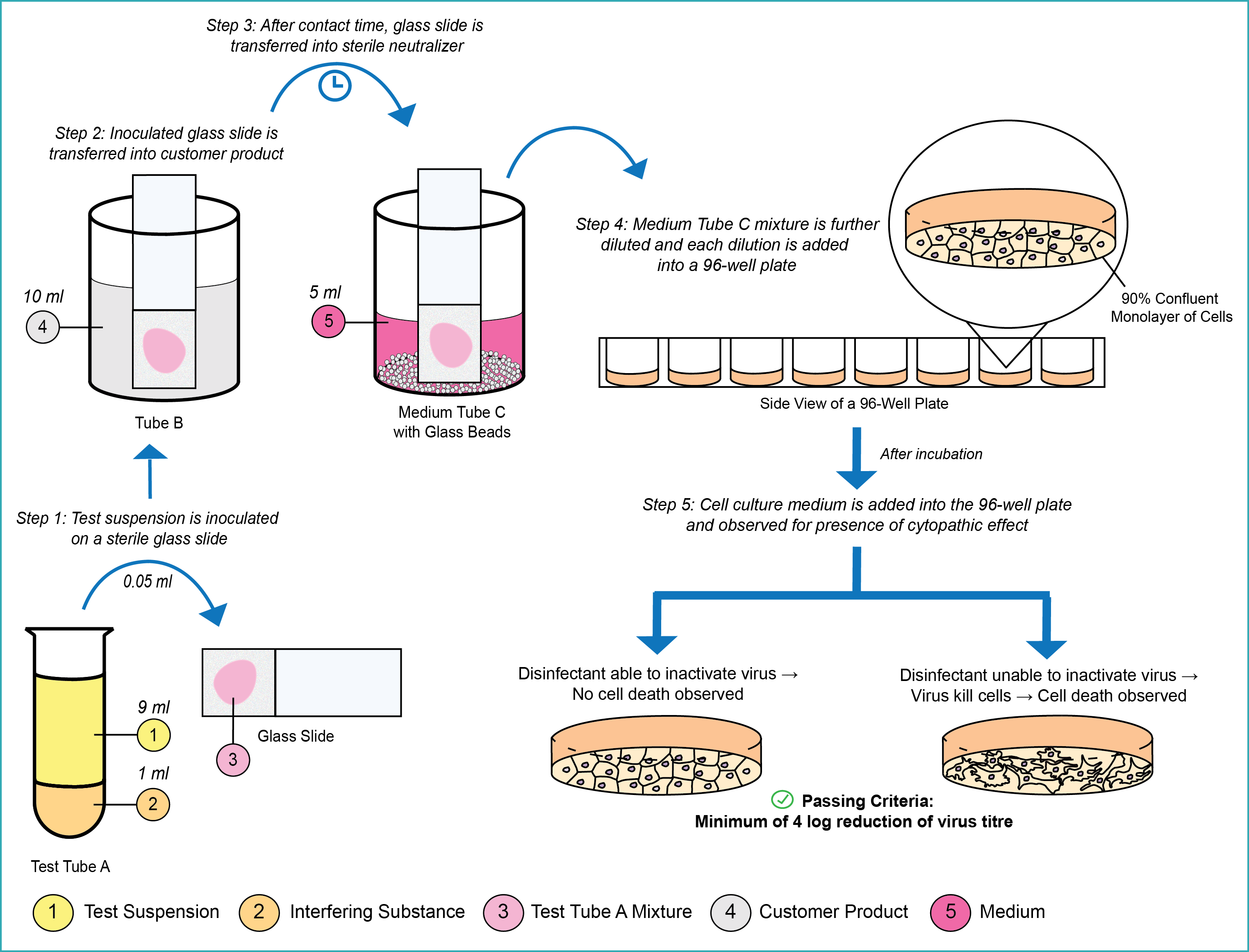
The infographic below provides a brief overview of the EN 17111 test method.
This test is suitable for evaluating instrument disinfectants used in the medical field.
Test Protocol
Step 1: The test suspension is inoculated onto a sterile glass slide.
Step 2: The inoculated glass slide is transferred into the customer’s product.
Step 3: After the specified contact time, the glass slide is transferred into a sterile neutralizer.
Step 4: The neutralized test mixture (Mixture C) is further diluted, and each dilution is added to a 96-well plate.
Step 5: Cell culture medium is added to the 96-well plate, and the cultures are observed for the presence of cytopathic effects (CPE).
Test Microorganisms
These are the mandatory virus strains for testing according to virucidal activity claims:
Virucidal Activity for Instrument Disinfectants Used Under <40°C:
Adenovirus
Murine norovirus
Δ The product shall pass against Poliovirus, Adenovirus and Murine Norovirus in EN 14476 prior to EN 17111
Virucidal Activity for Instrument Disinfectants Used Under ≥40°C:
Murine parvovirus
Virucidal Activity Against Enveloped Virus:
Vaccinia virus
Wish to add more microorganisms? Click here for our full list of microorganisms.
Contact Time & Concentration
The test concentration is chosen according to the manufacturer’s recommendation.
The contact time recommended by the test method is no longer than 60 minutes.
Soiling Conditions
Interfering substances, or commonly referred to as soiling, are used to mimic organic substances found on human skin, surfaces, and instruments. These are the available soiling conditions according to the test method:


 Deutsch
 中文
 日本語
 Português
 Français
 Español
 العربية