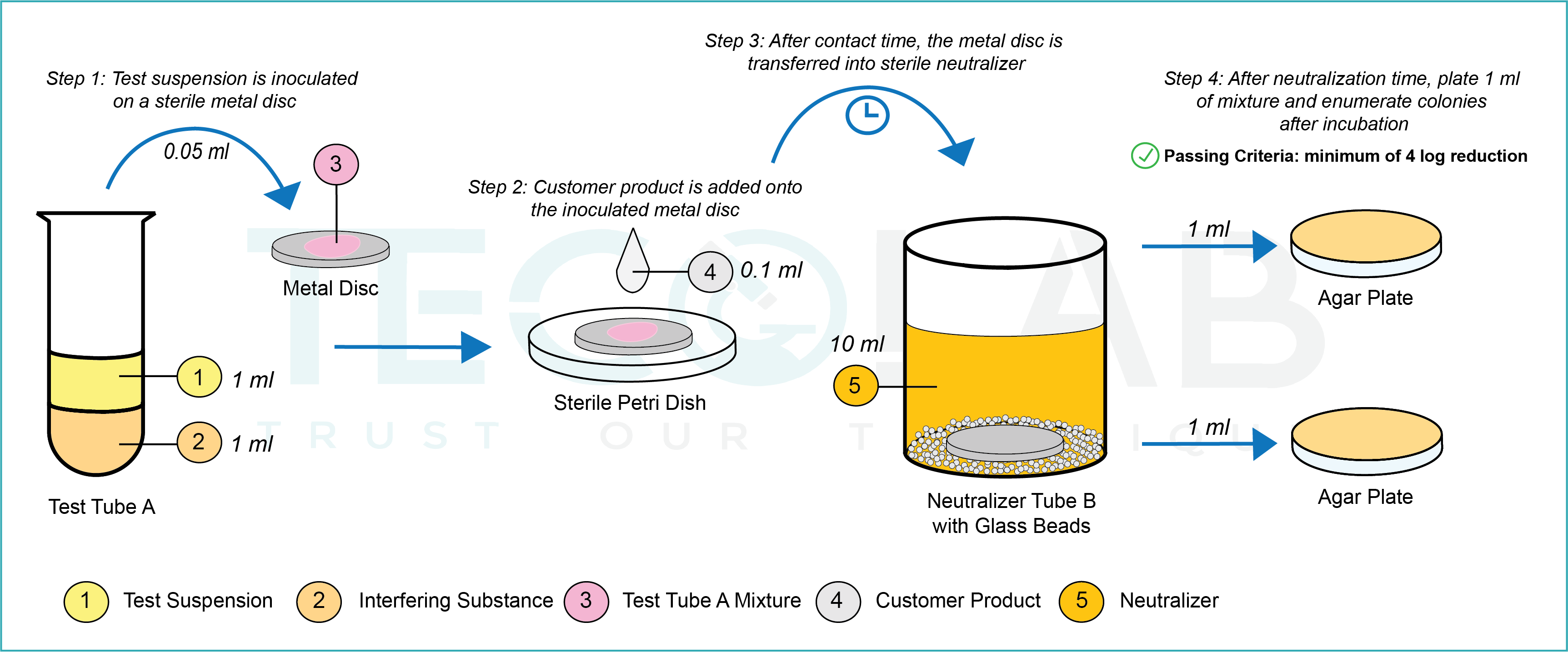
This test method is suitable for surface disinfectants used without mechanical action. If your product requires a wiping action, there is currently no standard method for the veterinary area but modifications to EN 16615 is possible.
Test Protocol
Step 1: The test suspension is inoculated onto a sterile stainless steel disc and allowed to dry.
Step 2: The customer product is applied to the inoculated stainless steel disc and allowed to remain for the selected contact time.
Step 3: After the contact time, the stainless steel disc is transferred into a sterile neutralizer to stop the antimicrobial activity.
Step 4: After the required neutralization time, 1 mL of the neutralized mixture is plated and incubated. The surviving colonies are then enumerated.
Test Microorganisms
These are the mandatory test organisms:
Pseudomonas aeruginosa
Staphylococcus aureus
Enterococcus hirae
Wish to add more microorganisms? Click here for our full list of microorganisms.
Contact Time & Concentration
The test concentration is chosen according to the manufacturer’s recommendation.
The allowed contact time to be tested is between 1 minute – 120 minutes depending on practicality of product use and manufacturer’s recommendation.
Test temperature may be chosen based on product’s application of use but between 5°C to 40°C.
Soiling Conditions
Interfering substances, or commonly referred to as soiling, are used to mimic organic substances found on human skin, surfaces, and instruments. These are the available soiling conditions according to the test method:
Low level soiling: 3.0 g/L bovine serum albumin
High level soiling: 10.0 g/L bovine serum albumin + 10.0 g/L yeast extract
Need help with your testing requirements?
Have questions about this test method or your product? Our technical team is here to assist you.


 Deutsch
 中文
中文
 日本語
日本語
 Português
 Français
 Español
 العربية