Quantitative Suspension Test for the Evaluation of Bactericidal Activity in the Food, Industrial, Domestic and Institutional Areas
EN 1276 is an essential European Standard used to evaluate the minimum bactericidal activity for chemical disinfectants used in the food, industrial, domestic and institutional areas.
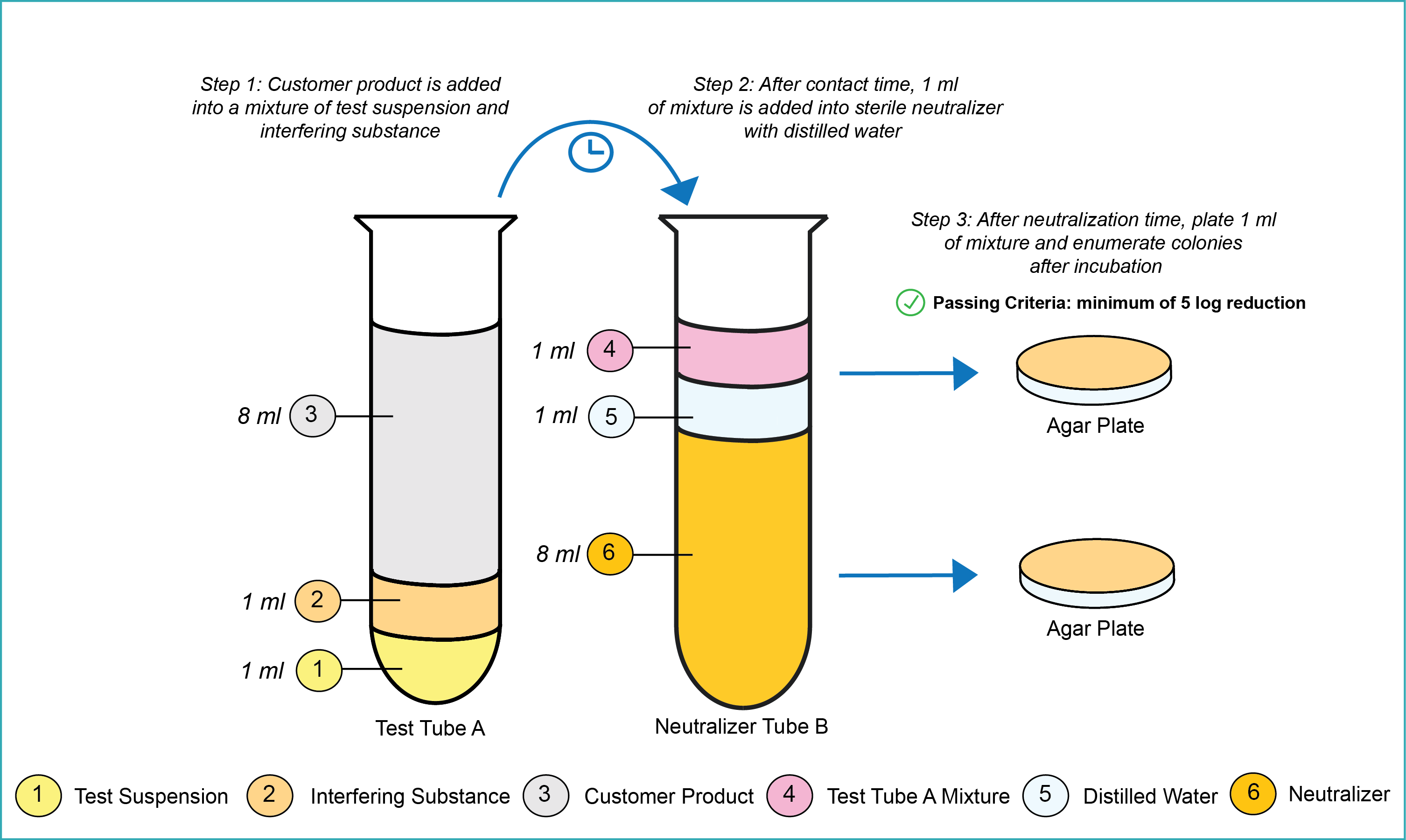
The infographic below provides a brief overview of the EN 1276 test method.
This testing method applies to the following areas:
Hand Hygiene Products
General Purpose Disinfectants
Test Protocol
Step 1: Customer product is added to a mixture of the test suspension and interfering substance.
Step 2: After the selected contact time, 1 mL of the test mixture is transferred into a neutralizer containing distilled water to stop the disinfectant activity.
Step 3: After the required neutralization time, the neutralized mixture is plated and incubated. Surviving bacterial colonies are then enumerated to determine the log reduction.
The test protocol is performed under the specified conditions according to the product category and intended application.
Test Microorganisms
These are the minimum test organisms for bactericidal activity:
Pseudomonas aeruginosa
Staphylococcus aureus
Enterococcus hirae
Escherichia coli (not applicable for hand hygiene purpose)
Escherichia coli K12 (for hand hygiene product only)
For temperatures at ≥40°C:
Enterococcus faecium
Wish to add more microorganisms? Click here for our full list of microorganisms.
Contact Time & Concentration
The test concentration is chosen according to the manufacturer’s recommendation.
The contact time recommended by the test method for hand hygiene products are 30 seconds or 60 seconds.
The contact time recommended by the test method for general purpose disinfectants is 1 minute to 5 minutes or 60 minutes depending on the product application.
The customer can choose different contact time based on manufacturer’s recommendation.
Soiling Conditions
Interfering substances, or commonly referred to as soiling, are used to mimic organic substances found on human skin, surfaces, and instruments. These are the available soiling conditions according to the test method:
Clean condition: 0.3 g/L bovine serum albumin
Dirty condition: 3.0 g/L bovine serum albumin
Need help with your testing requirements?
Have questions about this test method or your product? Our technical team is here to assist you.


 Deutsch
 中文
中文
 日本語
日本語
 Português
 Français
 Español
 العربية